Posted
12th July 2019
Research
In the AJIC special issue on ‘Disinfection, sterilization, and antisepsis’, there is a helpful State-of-the-Science mini-review on the importance of biofilms in medical device reprocessing and healthcare surface disinfection. The review covers the growing appreciation that biofilms present a tough challenging to cleaning, disinfection, and sterilisation attempts for both medical devices and surfaces in healthcare settings.
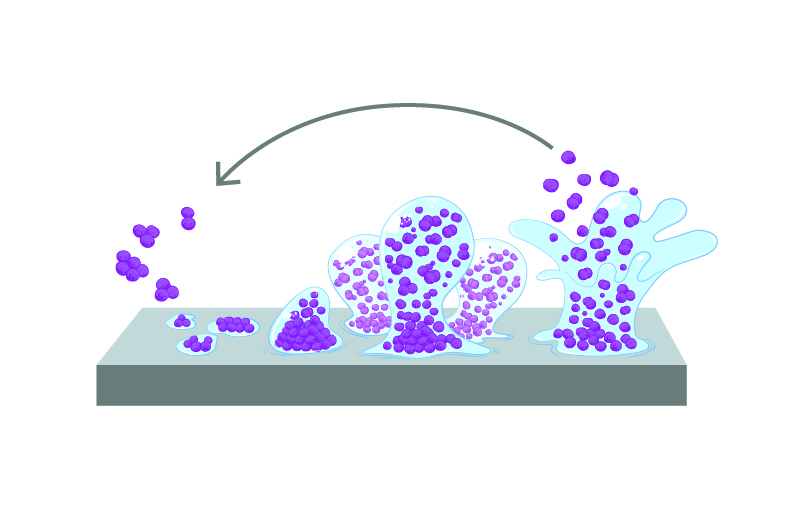
The review draws a helpful distinction between ‘traditional’ biofilms, that form on the aqueous-hard surface interfaces (e.g. teeth and ships hulls), and dry surface biofilm that you commonly find on a hospital surfaces. This dry surface biofilm is described as ‘Build-up Biofilm’, due to the formation under repeated rounds of hydration, rather than continuous hydration as with a traditional biofilm.
The review then covers the evidence that biofilms are a common issue both for medical devices and environmental surfaces. In both cases, biofilms are frequently identified, microbes in biofilms can persist standard cleaning / disinfection / sterilisation, and have been linked to clinical issues (e.g. outbreaks). For example, in the context of medical devices, outbreaks have been linked to biofilms on flexible endoscopes. And in the context of environmental surfaces, an in vitro model demonstrated that bacteria can be transmitted from dry surface biofilms to gloved hands, illustrating a potential role in transmission.
Whilst the role of biofilms in the transmission of pathogens on medical devices and healthcare surfaces, current and future cleaning, disinfection, and sterilisation methods must be implemented and developed with biofilms in mind.
SHARE THIS ARTICLE







Tags
Latest News
Introducing HEXI HUB: A seamless transition in our product line
We’re pleased to announce an update to our product offering…
Innovative solutions for tackling Carbapenemase-producing Enterobacteriaceae (CPE) at King’s College Hospitals
King’s College Hospital NHS Foundation Trust, one of London’s largest…
Gloves Off: reducing unnecessary plastic waste during environmental cleaning and disinfection
In this blog, Dr Phil Norville discusses the momentum-gaining ‘Gloves…
Gloves Off: Navigating SDS sheets and skin safety claims in environmental decontamination products
In this blog, James Clarke (Head of R&D, Science &…