Posted
12th June 2017
Products
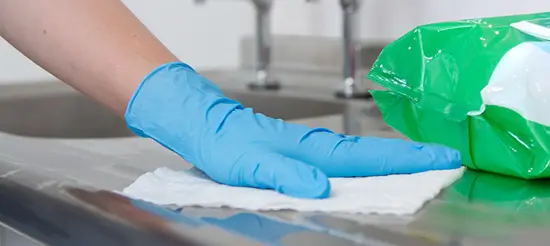
A Dutch laboratory evaluation of four different disinfectant applied by either spraying or wiping has found that most are effective against key hospital pathogens. However, the hydrogen peroxide spray was ineffective against VRE, suggesting a problem with hydrogen peroxide stability. The study tested the ability of a hydrogen peroxide solution (branded a sporicidal), QAC, alcohol, and glucoprotamin to inactivate clinical isolates of VRE, K. pneumoniae, and A. baumannii. The products were applied as either a spray or wipe following a 1 hour contact time. All disinfectants achieved a >5 log reduction on the organisms tested, with the exception of hydrogen peroxide sprayed onto VRE. Now, hydrogen peroxide is very effective against enterococci, so I suspect that this illustrates a problem with instability of the hydrogen peroxide in the disinfecant formulation. It is also worth noting that the long contact time (1 hour) is not representative of the real world application of these products, where a 1 minute contact time would be more appropriate! This study provides further evidence that QACs (the key active ingredient of Clinell Universal Wipes) can be used to provide stable and effective disinfectant wipes.
SHARE THIS ARTICLE







Tags
Latest News
Embracing sustainability and cost savings: The journey of Clinell Indicator Notes to paper-based solutions
At GAMA Healthcare, we’ve always prided ourselves on being at…
Introducing HEXI HUB: A seamless transition in our product line
We’re pleased to announce an update to our product offering…
Innovative solutions for tackling Carbapenemase-producing Enterobacteriaceae (CPE) at King’s College Hospitals
King’s College Hospital NHS Foundation Trust, one of London’s largest…
Gloves Off: reducing unnecessary plastic waste during environmental cleaning and disinfection
In this blog, Dr Phil Norville discusses the momentum-gaining ‘Gloves…